Built for one specific gap
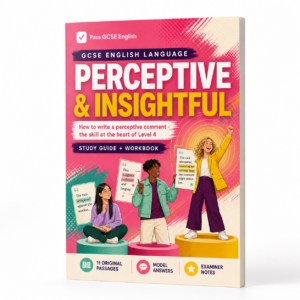
Perceptive & Insightful Comments — Study Guide & Workbook
Ready to write the kind of comment examiners call perceptive — on demand, under timed conditions? It turns perceptive comments GCSE English examiners reward into questions you can ask on demand.
In the exam
Paper 1 Question 2 · Paper 2 Question 3
Marked against
Assessment Objective 2 — language analysis
Share of the GCSE
20 marks · 12.5% of the GCSE
Ask a teacher what makes an answer perceptive and you’ll often get an honest shrug: you’ll know it when you see it, it comes with reading widely. That’s true, and unhelpful — wide reading takes years and you have an exam in months. This book takes the other route. It names the small set of moves an examiner actually rewards, shows a single comment climbing from Level 2 to Level 4 with every change labelled, and gives you seven questions you can put any quotation through.
Built for the AQA GCSE English Language (8700) specification — for students sitting the exam in summer 2027, whether you’re resitting or sitting it for the first time.
What’s inside
- The seven questions that produce perceptive analysis
- One comment climbing Level 2 → 3 → 4, move by move
- Eleven non-fiction activities with real extracts
- Model answers with examiner notes
- 144 pages, A4, write-in
Why clear analysis keeps landing in the middle
Your analysis is accurate, organised and perfectly reasonable, and it keeps coming back in the middle band. Ask what would lift it and the usual answer is to read more widely — true, and no use at all when the exam is in months. Perceptive is not a better technique spotted. It is a better question asked of the same quotation. The difficulty is rarely comprehension. It is not knowing which questions produce the deeper answer.
This workbook breaks that skill into clear, manageable steps, helping you understand what examiners are looking for and apply it independently.
Built for a specific gap, not a general topic
This workbook is suitable for you if you are:
- Preparing for AQA GCSE English Language
- Writing clear, competent analysis and landing in the middle band
- Working independently, with a tutor, in class or revising at home
Five things you’ll be able to do
A perceptive comment doesn’t find a better technique than a clear one. It asks better questions of the same quotation — and questions can be taught.
Find every connotation a single word carries, rather than settling for the first meaning that fits.
Say what a writer is implying but not stating, and why the silence is doing work.
Notice where a word normally belongs and what moving it somewhere else achieves.
Explain how a text positions you as a reader before you’ve decided anything.
Apply these skills confidently in exam-style questions.
Learn the moves, then run them eleven times
The activities build gradually from explanation and guided practice to independent exam-style work. Part A teaches the engine. Part B is where you use it, on eleven genuinely different non-fiction extracts, with model answers to check yourself against. You can work through the book in order, or use individual sections to target a particular weakness.
Part A — the engine
What ‘perceptive’ means to AQA, one comment climbing the levels with every edit named, and the seven questions you ask any quotation.
Part B — eleven activities
Tech doping · cave diving · dinosaurs · released UFO files · the end of Game of Thrones · a lunar mission · then and now · microplastics · greenwashing · ocean exploration · robotics.
Check
Model answers with examiner notes down the margin, plus a glossary and a progress tracker.
What you get across the 144 pages
A repeatable toolkit that turns a quotation into a perceptive comment — with guidance on which two or three to use under time pressure.
One comment on one word, rewritten from Level 2 to Level 4, with each change explained as it happens.
Real non-fiction subjects students actually want to read about, not sanitised practice text.
Built for Paper 1 Question 2 (8 marks) and Paper 2 Question 3 (12 marks) — the same skill, marked the same way.
Full responses with examiner notes, so you can see what earned each tick.
A progress tracker and glossary, plus honest guidance on where your winnable marks actually are.
Where this gets you
By the end of the workbook you’ll have a set of questions you can run on any quotation, the judgement to pick the two or three worth asking when the clock is going, and a clearer understanding of how to improve the quality of your answers.
‘Perceptive’ isn’t a personality. It’s a set of questions you ask a quotation — and once you have the questions, you can ask them on demand.
The specifics
- Exam board: AQA
- Format: A4 paperback workbook
- Length: 144 pages
- Subject: GCSE English Language
- Answers included: Yes
- Suggested completion time: Around 12 hours, or one activity per session
- Suitable for: Independent study, revision, tutoring and classroom learning
- Product code: PGE-PI-PB
- Edition: First edition, 2026
- Publisher: Pass GCSE English
- Series: Pass GCSE English
- Book: Standalone title
Part of the eleven-book Pass GCSE English range. It goes deeper on the language question than the Language Techniques workbook, and the two work well together.
Get the free vocabulary sampler
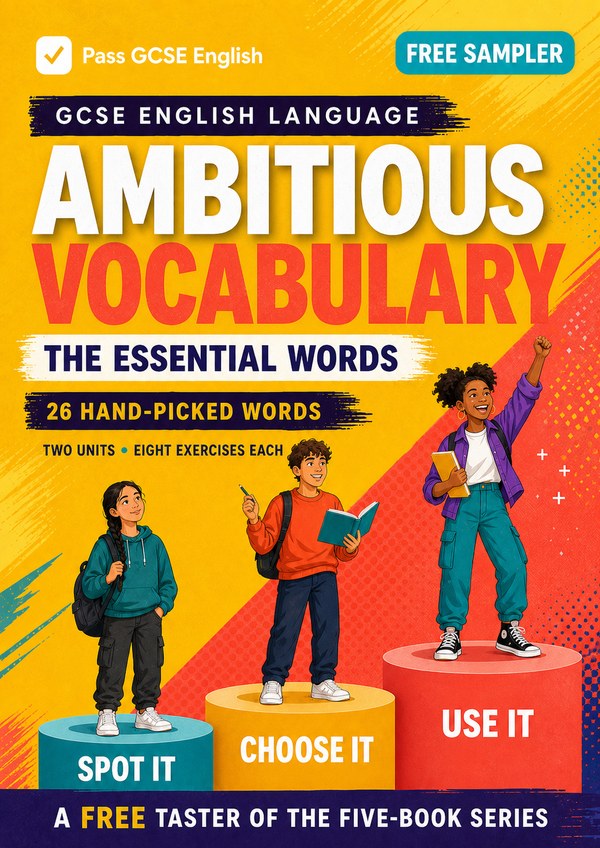
Ambitious Vocabulary for Level 4 — The Essential Words. Twenty-six hand-picked words across two units, the same eight exercises the paid workbooks use, and a full answers section. A working slice of the series, not a teaser with the useful bits removed.
- 18 pages, free, downloads straight away
- Unit 1 aimed at Paper 2, Unit 2 at Paper 1
- Full answers and model responses included
Download it now
Download the free sampler (PDF)
No email address needed and nothing to sign up for. Save it, print it, or work through it on screen.