Built for one specific gap
Beyond Level 3: Punctuation — Study Guide & Workbook
Ready to stop losing technical accuracy marks to punctuation you already half-know? This GCSE English punctuation workbook is about range, not just accuracy.
In the exam
Paper 1 Question 5 · Paper 2 Question 5
Marked against
Assessment Objective 6 — punctuation
Share of the GCSE
Part of the 32 marks (20%) for Assessment Objective 6
This workbook assumes you know what a comma is. It is built for the narrower and far more valuable problem most candidates actually have: you punctuate accurately but narrowly. Full stops and commas are secure, a semicolon or dash turns up occasionally — but not on purpose, and not consistently. Technical accuracy is worth 16 marks per writing task, 32 across both papers, and that gap between “correct” and “deliberate” is what this book closes, one mark at a time.
Built for the AQA GCSE English Language (8700) specification — for students sitting the exam in summer 2027, whether you’re resitting or sitting it for the first time.
Look inside
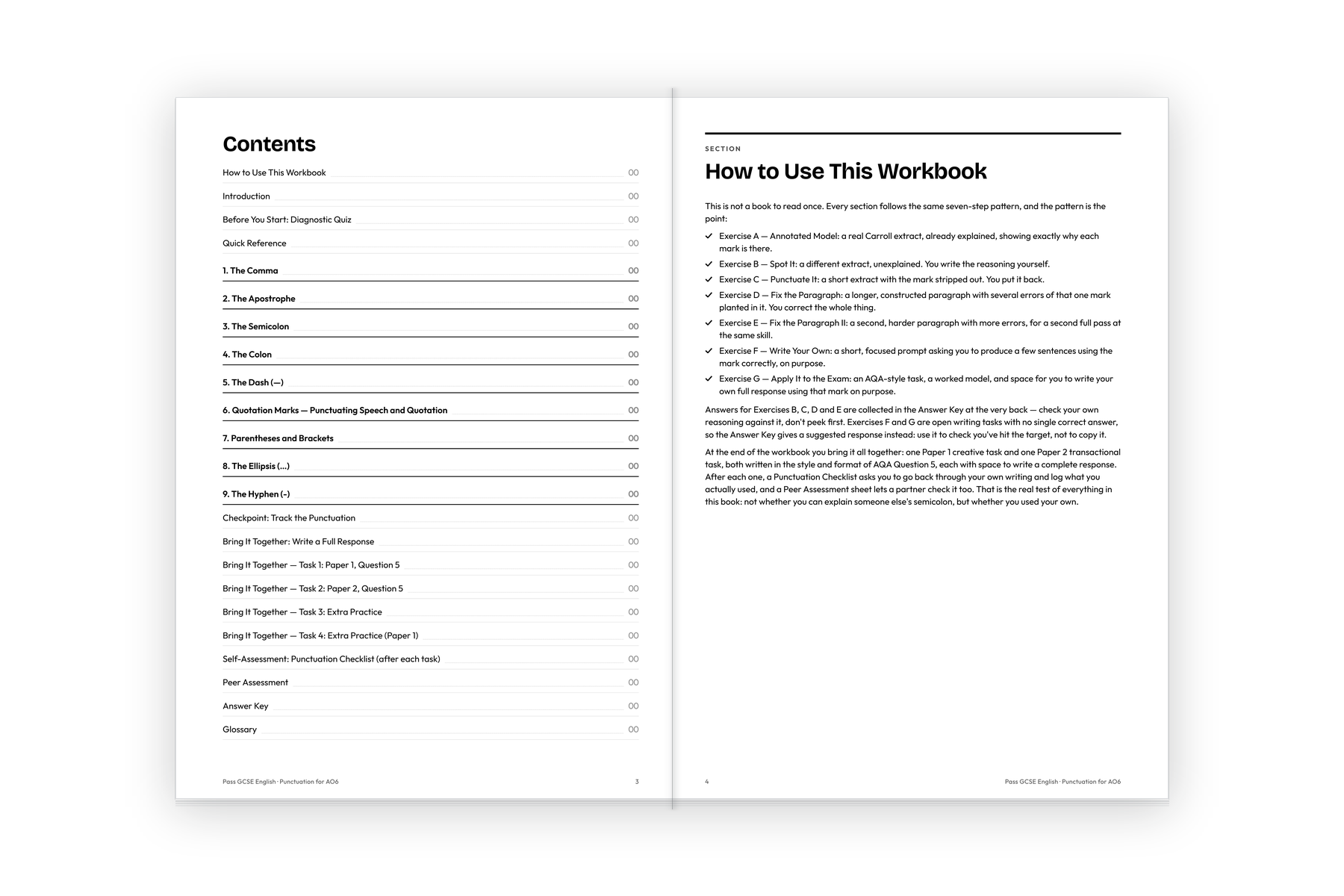
Click the image to see these pages full size.
Pages 3–4: the contents, and the seven-step pattern every section follows — annotated model, spot it, punctuate it, fix the paragraph twice, write your own, then an AQA-style task with space for a full response.
What’s inside
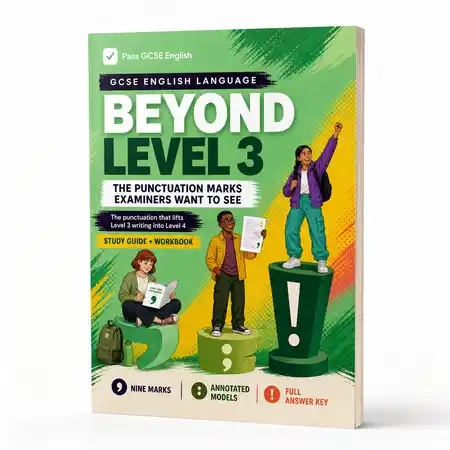
- Nine punctuation marks, one section each
- A seven-step sequence (Exercises A–G) in every section
- Diagnostic quiz, checkpoint and quick reference
- Four full write-in Question 5 tasks
- Answer key and glossary — 96 pages
Why accurate is not the same as deliberate
Your full stops and commas are secure. A semicolon or a dash turns up occasionally, but not on purpose and not consistently — and when someone asks why it is there, the honest answer is that it sounded right. Technical accuracy is worth 16 marks per writing task, 32 across both papers, and most of the gap sits between punctuating correctly and punctuating on purpose. The difficulty is rarely accuracy. It is range you can explain.
This workbook breaks that skill into clear, manageable steps, helping you understand what examiners are looking for and apply it independently.
Built for a specific gap, not a general topic
This workbook is suitable for you if you are:
- Preparing for AQA GCSE English Language
- Writing accurately but narrowly, and after the marks above the middle of the technical accuracy band
- Working independently, with a tutor, in class or revising at home
Five things you’ll be able to do
Level 4 technical accuracy is not a different skill from Level 3. It is the same punctuation, used correctly every time and deployed because you chose it.
Use the semicolon, colon, dash, ellipsis, hyphen and parentheses on purpose, not by accident.
Explain why a mark is there, in a real extract, rather than guessing from how the sentence sounds.
Find and fix planted errors across a whole paragraph — the skill you need for your own proofreading.
Punctuate speech and quotation correctly, which is where creative writing most often loses accuracy marks.
Apply these skills confidently in exam-style questions.
The same seven steps, nine times over
The activities build gradually from explanation and guided practice to independent exam-style work. Every section follows an identical pattern, and the pattern is the point — by the third mark you stop learning the format and start learning the punctuation. You can work through the book in order, or use individual sections to target a particular weakness.
See it
Exercise A gives an annotated model, already explained. Exercise B gives a fresh extract with nothing explained — you write the reasoning.
Fix it
Exercise C strips the mark out for you to restore. Exercises D and E plant errors in two full paragraphs, the second harder than the first.
Use it
Exercise F asks for sentences of your own. Exercise G gives an exam-style task, a worked model, and space for a complete response.
What you get across the 96 pages
Comma · apostrophe · semicolon · colon · dash · quotation marks · parentheses and brackets · ellipsis · hyphen
A quiz before you start, so you spend your time on the marks you actually avoid.
Seven per section across nine sections, from annotated model to full exam response.
Four write-in Question 5 tasks — one Paper 1 creative, one Paper 2 transactional, plus two extra.
A punctuation checklist to log what you used, and a peer-assessment sheet for a partner to mark.
A full answer key for Exercises B–E, with suggested responses for the open writing tasks.
Where this gets you
By the end of the workbook you’ll be reaching for a wider range of punctuation deliberately and correctly, able to prove it by auditing your own writing rather than guessing, and clearer about how to improve the quality of your answers.
Accuracy is where most candidates stop. Range is what the marks are actually for — and range is learnable in an afternoon per mark.
The specifics
- Exam board: AQA
- Format: A4 paperback workbook
- Length: 96 pages
- Subject: GCSE English Language
- Answers included: Yes
- Suggested completion time: Around 12 to 15 hours, or one punctuation mark per session
- Suitable for: Independent study, revision, tutoring and classroom learning
- Product code: PGE-BL3-PB
- Edition: First edition, 2026
- Publisher: Pass GCSE English
- Series: Pass GCSE English
- Book: Standalone title
Part of the eleven-book Pass GCSE English range. It pairs naturally with the Transactional Writing workbook, which covers the content and organisation half of the same Question 5.
Get the free vocabulary sampler
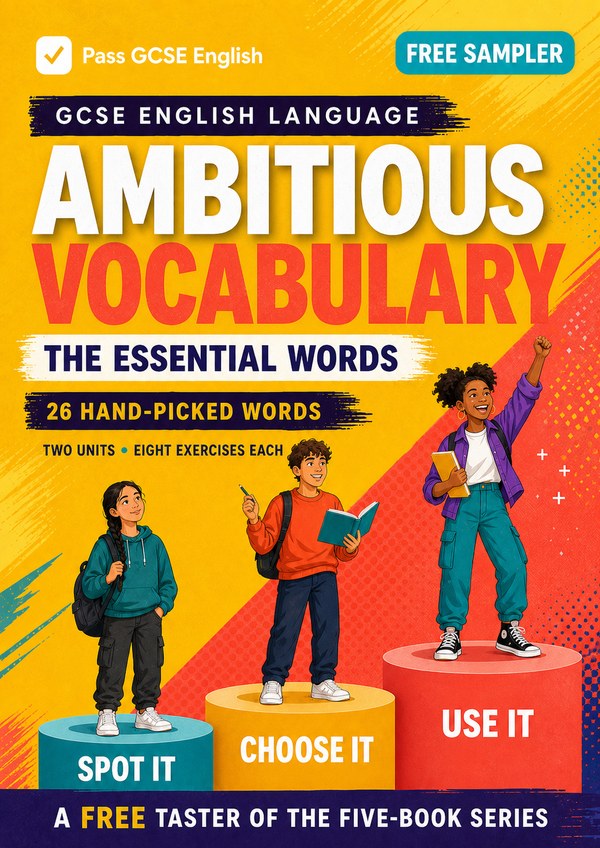
Ambitious Vocabulary for Level 4 — The Essential Words. Twenty-six hand-picked words across two units, the same eight exercises the paid workbooks use, and a full answers section. A working slice of the series, not a teaser with the useful bits removed.
- 18 pages, free, downloads straight away
- Unit 1 aimed at Paper 2, Unit 2 at Paper 1
- Full answers and model responses included
Download it now
Download the free sampler (PDF)
No email address needed and nothing to sign up for. Save it, print it, or work through it on screen.