Built for one specific gap
Ambitious Vocabulary — Workbook 2
Ready to write about difficult feelings, moral choices and contested arguments without reaching for the same six words? This workbook builds the kind of ambitious vocabulary GCSE examiners actually reward.
In the exam
Paper 1 Question 5 · Paper 2 Question 5
Marked against
Assessment Objective 6 — vocabulary (feelings, morality and argument)
Share of the GCSE
Part of the 32 marks (20%) for Assessment Objective 6
Book 2 picks up where Book 1 left off and goes somewhere harder. The four themes are the same, but the units underneath them are new and more demanding: Difficult Feelings, Strength & Courage and Moral Character; Building the Case, Challenge & Scrutiny and Structure & Strategy; Places & Spaces, People & Presence and Abstract Qualities; Making Moves, Reactions & Responses and Moral Choices. Each unit teaches around twenty words with definitions and exam-style example sentences, then works them until you can use them without thinking about it.
Built for the AQA GCSE English Language (8700) specification — for students sitting the exam in summer 2027, whether you’re resitting or sitting it for the first time.
Look inside
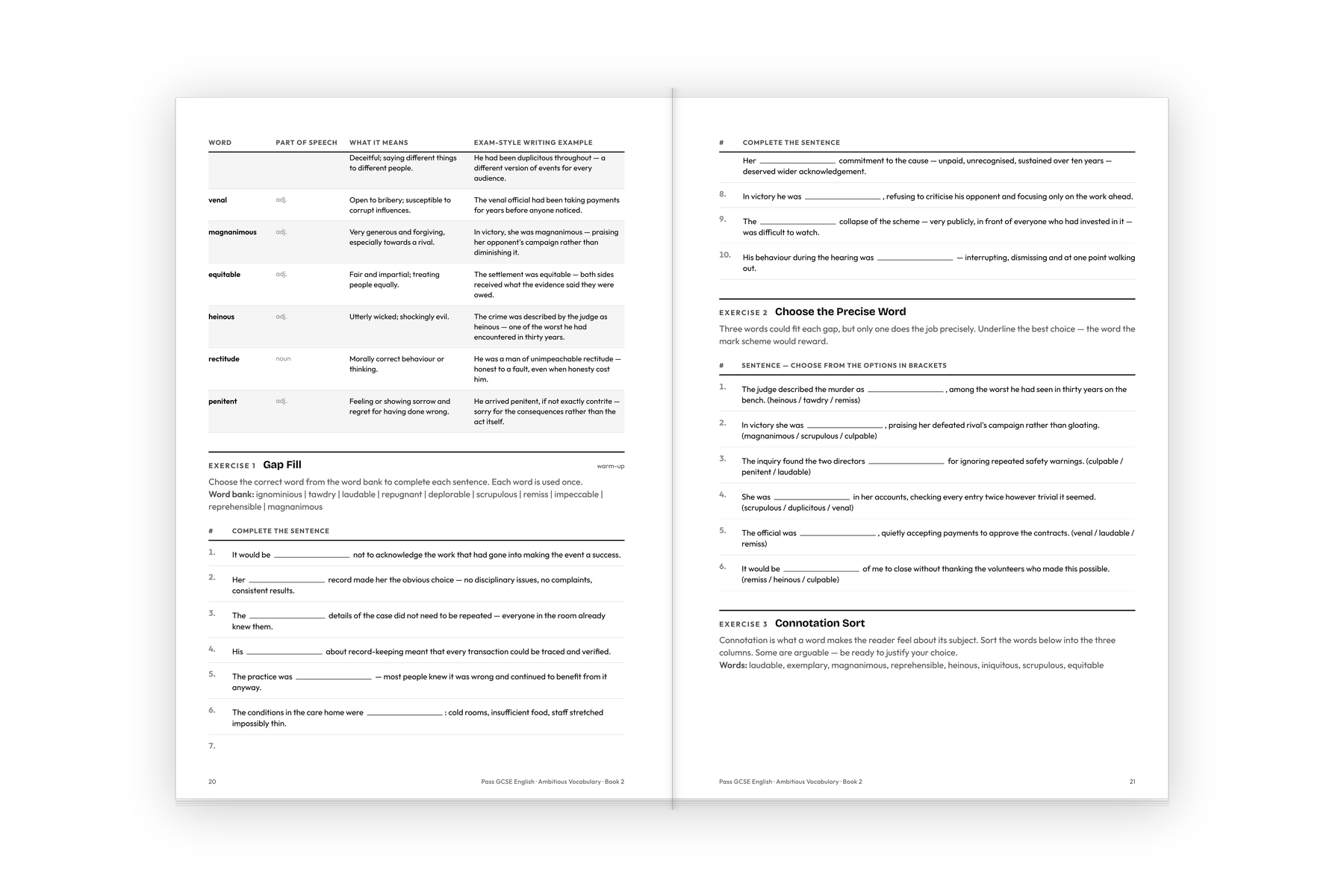
Click the image to see these pages full size.
Pages 20–21 of Book 2: the close of a unit’s word reference table, then three of the eight exercises — Gap Fill, Choose the Precise Word and Connotation Sort.
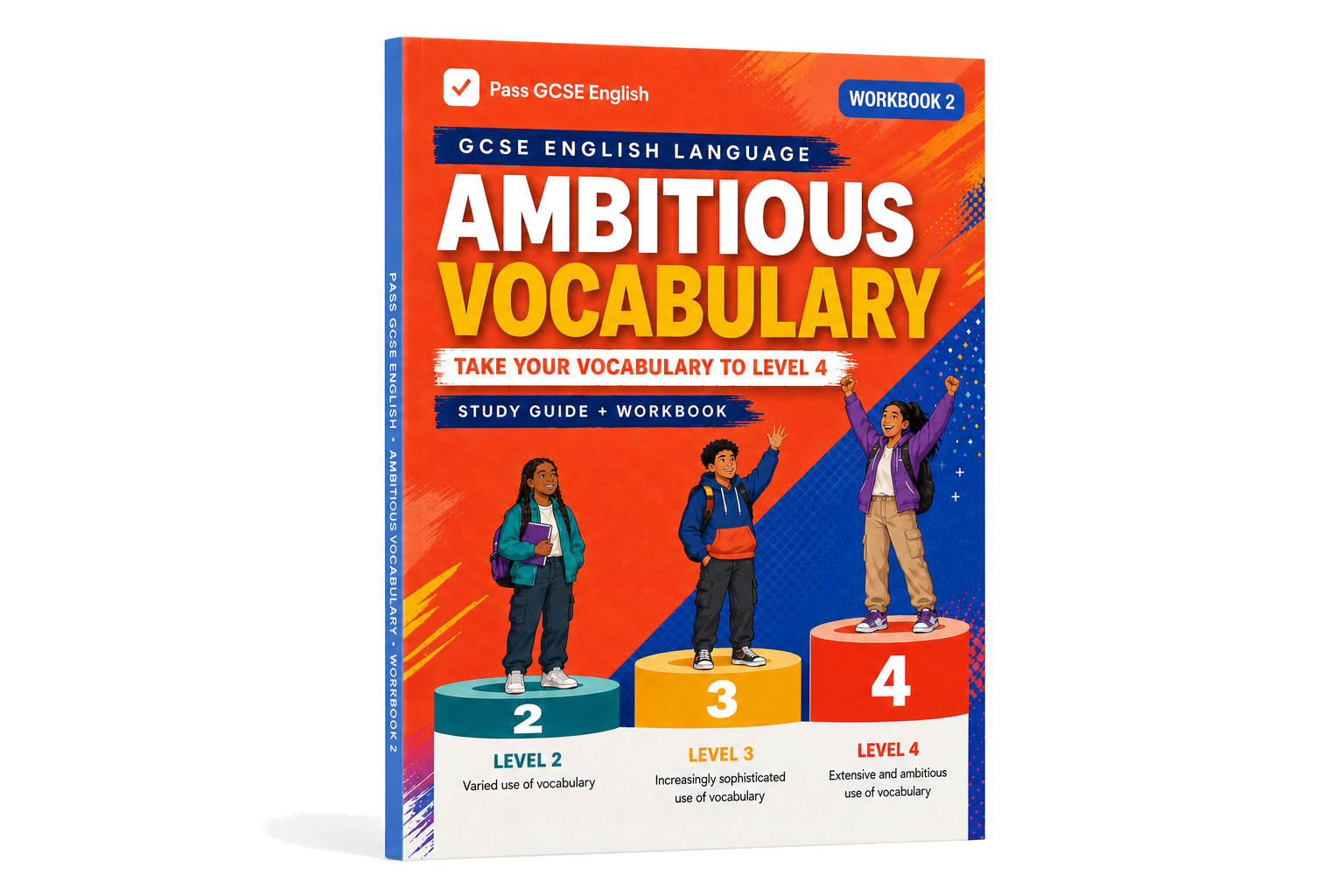
What’s inside
- 12 new units across the same four themes
- Around 20 words per unit — roughly 240 in all
- The same eight exercises, on harder vocabulary
- Full Answers & Model Responses section
- 104 pages, A4, write-in
Why the hard subjects come out vague
Your vocabulary covers the easy subjects and runs out on the difficult ones. Grief, dread and exhaustion all arrive as “sad”; an argument you are supposed to be defending arrives as “I think”. In analysis it shows up as a word chosen for how strong it sounds rather than for the feeling it actually carries. The difficulty is rarely a small vocabulary. It is not having a precise word ready when the subject gets hard.
This workbook breaks that skill into clear, manageable steps, helping you understand what examiners are looking for and apply it independently.
Built for a specific gap, not a general topic
This workbook is suitable for you if you are:
- Preparing for AQA GCSE English Language
- Secure on the basics and ready for the harder subjects — grief, courage, moral pressure, an argument that has to be defended
- Working independently, with a tutor, in class or revising at home
Five things you’ll be able to do
Book 2 leans into the vocabulary students most often need and least often have: words for difficult emotion, and words for holding a line in an argument.
Name a difficult feeling exactly — the difference between dejected, listless and apathetic — instead of settling for “sad”.
Sort words by what they make a reader feel, not just what they mean, and justify a choice that could go either way.
Build and challenge a case with vocabulary that signals scrutiny rather than opinion.
Pair ambitious words with the partner words they naturally belong to, so nothing sounds bolted on.
Apply these skills confidently in exam-style questions.
Guided first, independent by the end
The activities build gradually from explanation and guided practice to independent exam-style work. All twelve units follow the same eight-exercise sequence you know from Book 1, so nothing about the format slows you down — only the vocabulary gets harder. You can work through the book in order, or use individual sections to target a particular weakness.
Learn
A reference table teaches the unit’s twenty words, then Gap Fill checks you can place each one.
Practise
Choose the Precise Word, Connotation Sort, Collocations, Spot the Misuse and Purposeful or Padded? turn recognition into judgement.
Apply
Sentence Upgrade (Grade 4 → Grade 8) and Two Words, One Sentence make you produce the vocabulary yourself.
What you get across the 104 pages
Difficult Feelings · Strength & Courage · Moral Character
Building the Case · Challenge & Scrutiny · Structure & Strategy
Places & Spaces · People & Presence · Abstract Qualities
Making Moves · Reactions & Responses · Moral Choices
Eight per unit, from Gap Fill to Two Words, One Sentence — 96 exercises in all.
Full Answers & Model Responses, with the reasoning explained rather than a bare key.
Where this gets you
By the end of the workbook you’ll have precise language for the subjects students most often write about badly — difficult emotion, moral pressure and contested argument — and a clearer understanding of how to improve the quality of your answers, because you’ll use that language only where it earns its place.
There is no such thing as a “Level 4 word list”. Level 3 sounds like someone starting to reach for it. Level 4 sounds like someone who uses it every time, and always for a reason.
The specifics
- Exam board: AQA
- Format: A4 paperback workbook
- Length: 104 pages
- Subject: GCSE English Language
- Answers included: Yes
- Suggested completion time: Around an hour a unit — 12 to 15 hours in total
- Suitable for: Independent study, revision, tutoring and classroom learning
- Product code: PGE-AV-B2-PB
- Edition: First edition, 2026
- Publisher: Pass GCSE English
- Series: Pass GCSE English
- Book: 2 of 5
This is Workbook 2 in the five-book Ambitious Vocabulary for Level 4 series. It follows on naturally from Book 1, but the units stand alone — you can start here if these are the words you need.
Get the free vocabulary sampler
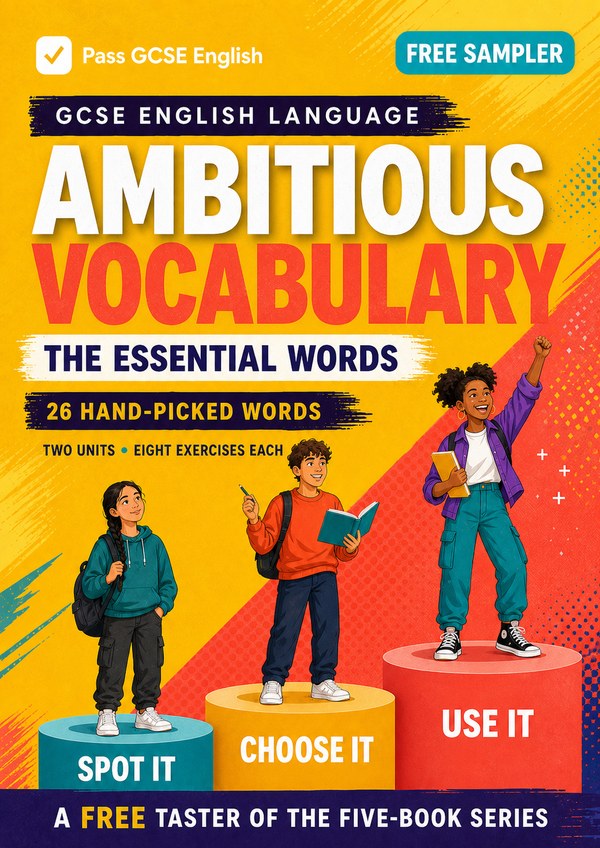
Ambitious Vocabulary for Level 4 — The Essential Words. Twenty-six hand-picked words across two units, the same eight exercises the paid workbooks use, and a full answers section. A working slice of the series, not a teaser with the useful bits removed.
- 18 pages, free, downloads straight away
- Unit 1 aimed at Paper 2, Unit 2 at Paper 1
- Full answers and model responses included
Download it now
Download the free sampler (PDF)
No email address needed and nothing to sign up for. Save it, print it, or work through it on screen.