Built for one specific gap
Transactional Writing — Study Guide & Workbook
Ready to write Question 5 for the mark scheme instead of guessing what the examiner wants? This GCSE transactional writing workbook starts with the decision that costs the most marks.
In the exam
Paper 2 Question 5
Marked against
Assessment Objectives 5 and 6 — writing
Share of the GCSE
40 marks · 25% of the GCSE
Paper 2 Question 5 is worth 40 marks — half your whole Paper 2 — and it is marked in a way most students never have explained to them. This book explains it, then trains you to make the exact moves an examiner rewards. Rather than showing you a Grade 8 answer and saying “write like this”, it takes an ordinary Level 2 answer and levels it up in front of you — Level 2, lower Level 3, upper Level 3, Level 4 — naming the criterion each edit has just met.
Built for the AQA GCSE English Language (8700) specification — for students sitting the exam in summer 2027, whether you’re resitting or sitting it for the first time.
Look inside
Click the image to see these pages full size.
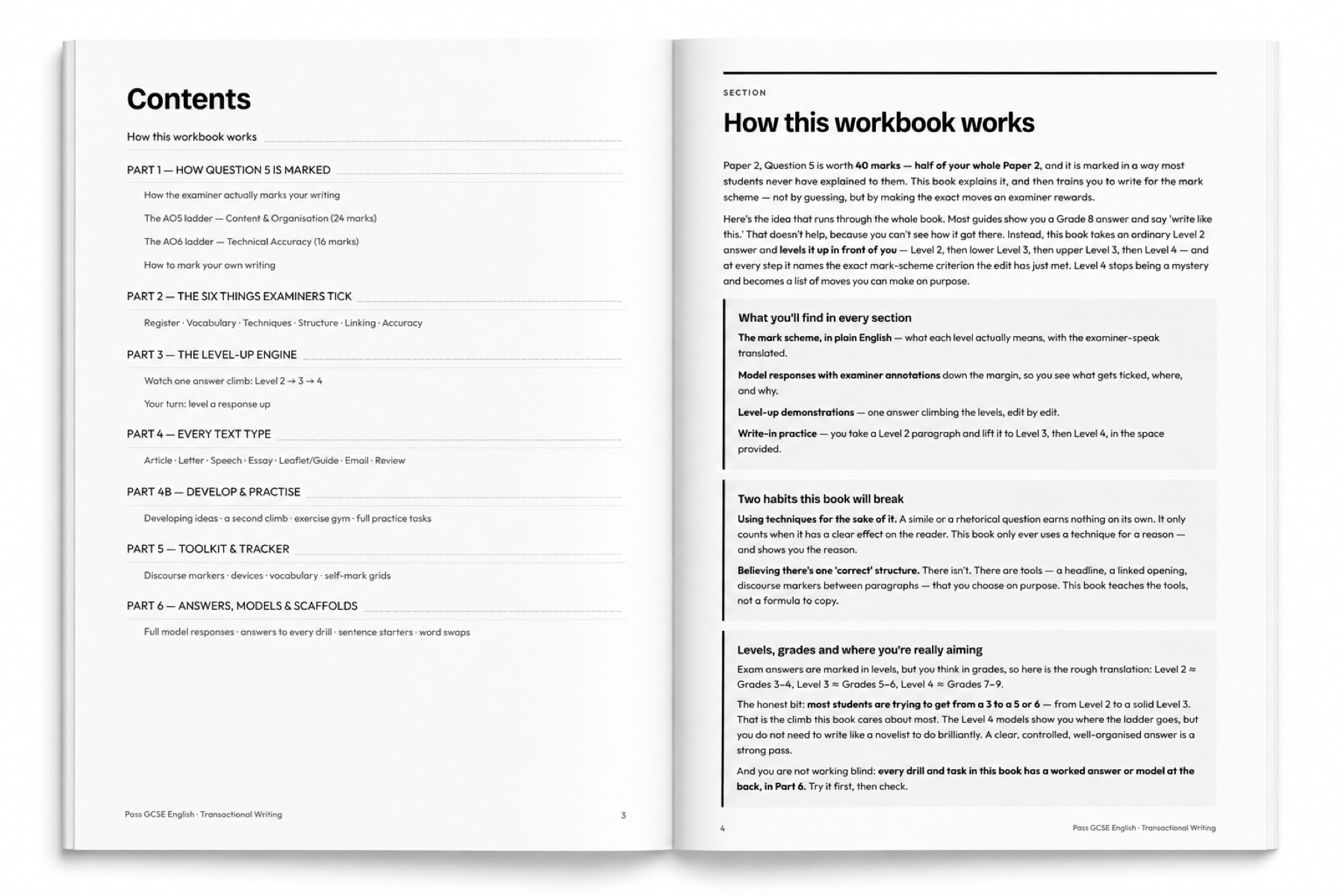
Pages 3–4 of Transactional Writing: the full contents, and how the book works — the mark scheme in plain English, and one answer climbing Level 2 to Level 4.
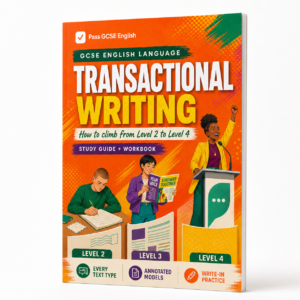
What’s inside
- All six text types, each with models
- The level-up engine: one answer climbing four levels
- The writing mark schemes in plain English
- Full models, answers and scaffolds in Part 6
- 120 pages, A4, write-in
Why Question 5 is lost before you write
Paper 2 Question 5 is worth 40 marks — half the paper — and a good deal of what separates a middle answer from a top one is decided in the first thirty seconds, when you choose a form and a register. Choose them wrong and no amount of good writing gets the marks back. The difficulty is rarely effort or ideas. It is not knowing what the mark scheme is rewarding before you start.
This workbook breaks that skill into clear, manageable steps, helping you understand what examiners are looking for and apply it independently.
Built for a specific gap, not a general topic
This workbook is suitable for you if you are:
- Preparing for AQA GCSE English Language
- Sitting Paper 2, especially if you plan well but lose marks on form, register or organisation
- Working independently, with a tutor, in class or revising at home
Five things you’ll be able to do
Most students lose Question 5 marks before they write a word, by picking a form and a register that don’t match the task. That decision takes thirty seconds.
Match form, audience and register to the task in the first thirty seconds, for any of the six text types.
Read both writing mark-scheme ladders in plain English and know exactly which features earn which band.
Take a Level 2 paragraph and lift it to Level 3, then Level 4, naming each change as you make it.
Choose structural tools — headline, linked opening, discourse markers — on purpose, instead of copying a formula.
Apply these skills confidently in exam-style questions.
Understand the marking, then write for it
The activities build gradually from explanation and guided practice to independent exam-style work. Six parts, in order: how it’s marked, what gets ticked, how an answer climbs, every text type, the toolkit, and full answers. You can work through the book in order, or use individual sections to target a particular weakness.
Understand
Part 1 explains how an examiner actually marks — reading from the top, starting low, letting your writing lift them. Part 2 names the six things they tick.
Climb
Part 3 is the level-up engine: watch one answer go Level 2 → 3 → 4, then do it yourself in the space provided.
Practise
Part 4 covers article, letter, speech, leaflet or guide, email and review. Part 4B adds an exercise gym and full practice tasks.
What you get across the 120 pages
Article · letter · speech · leaflet or guide · email · review — each with its own conventions and models.
One answer climbing Level 2 → lower 3 → upper 3 → Level 4, with the criterion named at every edit.
Register · vocabulary · techniques · structure · linking · accuracy — what examiners mark, one section each.
Model responses with examiner notes down the margin, so you see what gets ticked, where, and why.
Discourse markers, devices, vocabulary tables and self-mark grids.
Full model responses, answers to every drill, sentence starters and word-swap tables.
Want it marked?
This workbook shows you how Question 5 is marked. The Writing Lab marks what you actually write — a mark for AO5 and AO6, every judgement quoted from your own sentences, and one thing to practise next.
Two tasks marked free, no card. £11.99 a month after that, cancel any time.
Where this gets you
By the end of the workbook you’ll be able to choose a form and register in seconds, write to the criteria deliberately, mark your own work the way an examiner would, and have a clearer understanding of how to improve the quality of your answers.
Level 4 stops being a mystery and becomes a list of moves you can make on purpose.
The specifics
- Exam board: AQA
- Format: A4 paperback workbook
- Length: 120 pages
- Subject: GCSE English Language
- Answers included: Yes
- Suggested completion time: Around 15 hours, or one text type per session
- Suitable for: Independent study, revision, tutoring and classroom learning
- Product code: PGE-TW-PB
- Edition: First edition, 2026
- Publisher: Pass GCSE English
- Series: Pass GCSE English
- Book: Standalone title
Part of the eleven-book Pass GCSE English range. It covers the content and organisation half of Question 5; the Punctuation workbook covers the technical accuracy half.
Get the free vocabulary sampler
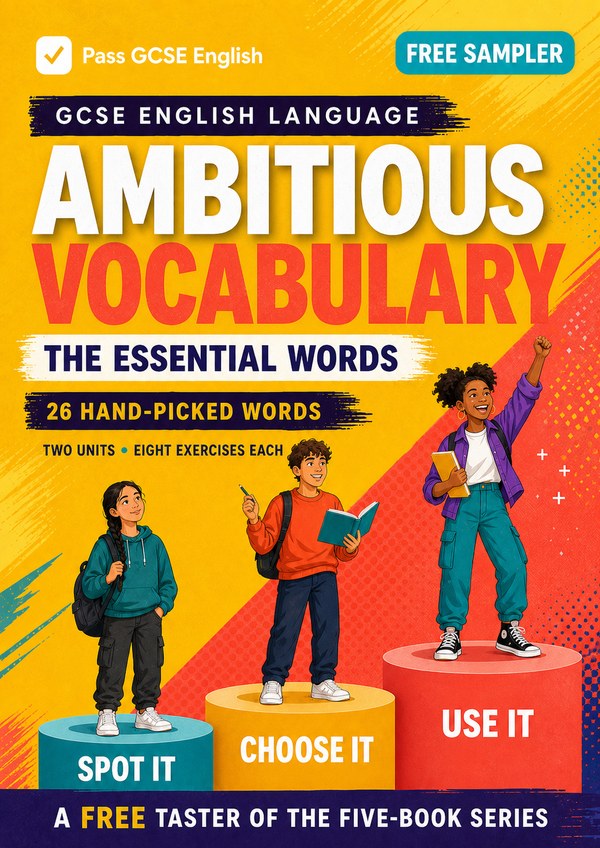
Ambitious Vocabulary for Level 4 — The Essential Words. Twenty-six hand-picked words across two units, the same eight exercises the paid workbooks use, and a full answers section. A working slice of the series, not a teaser with the useful bits removed.
- 18 pages, free, downloads straight away
- Unit 1 aimed at Paper 2, Unit 2 at Paper 1
- Full answers and model responses included
Download it now
Download the free sampler (PDF)
No email address needed and nothing to sign up for. Save it, print it, or work through it on screen.