Built for one specific gap
Language Techniques & Methods — Study Guide & Workbook
Ready to stop naming techniques and start explaining what they actually do? The GCSE English language techniques here are taught for choosing, not just naming.
In the exam
Paper 1 Questions 2 and 3 · Paper 2 Question 3
Marked against
Assessment Objective 2 — language and structure
Share of the GCSE
28 marks · 17.5% of the GCSE
Anyone can spot a simile. The mark is in choosing which of the ones in front of you is the one the question is asking about, and saying why. Every extract in this book contains two examples of each technique — and only one of them creates the effect you’ve been asked about. You have to read properly to answer, which is exactly what the exam requires. Eighteen units cover language and structure, and a third part turns the whole thing around and asks you to use the techniques in your own writing.
Built for the AQA GCSE English Language (8700) specification — for students sitting the exam in summer 2027, whether you’re resitting or sitting it for the first time.
Look inside
Click the image to see these pages full size.
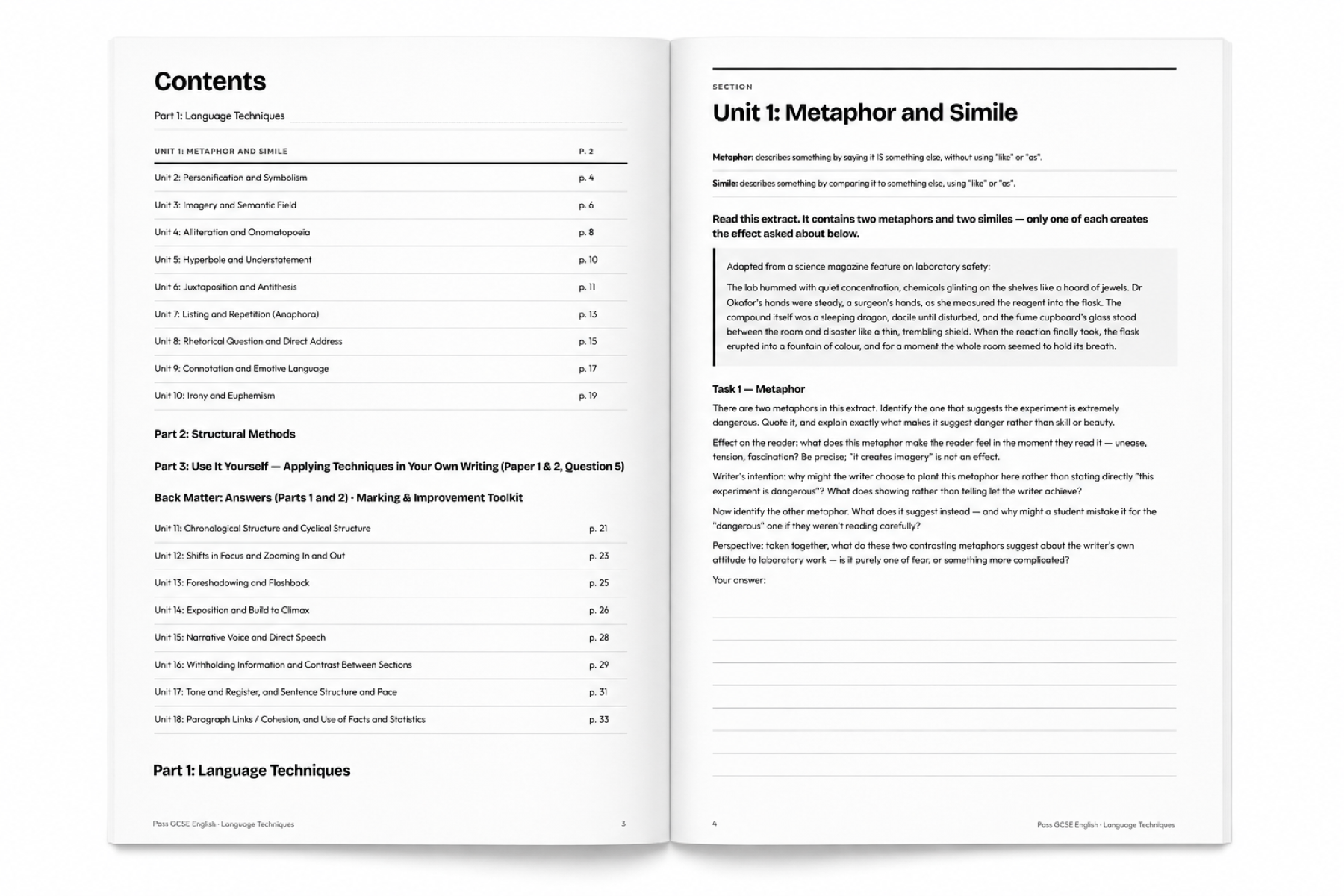
Pages 3–4 of Language Techniques & Methods: the full contents, and Unit 1 — an extract containing two metaphors and two similes, where only one of each creates the effect the question asks about.
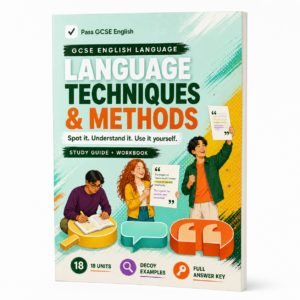
What’s inside
- 10 language units and 8 structure units
- Two examples of every technique — only one is right
- A third part on using techniques in your own writing
- Full answer key for every unit, plus a marking toolkit
- 164 pages, A4, write-in
Why naming the technique earns nothing
You spot the simile, name it, and say it creates imagery — and the mark does not come. The question was never whether you can find a technique; an extract is full of them, and more than one will fit. What earns the mark is choosing the example that answers the question actually asked, and saying precisely what it makes a reader feel. The difficulty is rarely identification. It is selection and effect.
This workbook breaks that skill into clear, manageable steps, helping you understand what examiners are looking for and apply it independently.
Built for a specific gap, not a general topic
This workbook is suitable for you if you are:
- Preparing for AQA GCSE English Language
- Able to identify techniques but losing marks explaining them, or writing analysis that reads as a list
- Working independently, with a tutor, in class or revising at home
Five things you’ll be able to do
Level 4 is not more techniques. It is the same techniques, chosen for a clear effect and sustained.
Pick the right example from an extract that offers you two, and say why the other one is the decoy.
Name what a choice makes a reader feel, precisely — “it creates imagery” is not an effect.
Explain why a writer showed rather than told, and what that choice let them achieve.
Analyse how a text is built — shifts in focus, withholding, cyclical structure, pace — not just what it says.
Apply these skills confidently in exam-style questions.
Analyse it, then do it yourself
The activities build gradually from explanation and guided practice to independent exam-style work. The book runs in three parts: two of analysis, one of production — because a technique you can only spot is worth half of one you can also use. You can work through the book in order, or use individual sections to target a particular weakness.
Part 1 — Language
Ten units: metaphor and simile · personification and symbolism · imagery and semantic field · alliteration and onomatopoeia · hyperbole and understatement · juxtaposition and antithesis · listing and repetition · rhetorical question and direct address · connotation and emotive language · irony and euphemism.
Part 2 — Structure
Eight units: chronological and cyclical structure · shifts in focus and zooming · foreshadowing and flashback · exposition and build to climax · narrative voice and direct speech · withholding and contrast · tone, register, sentence structure and pace · paragraph links and use of facts.
Part 3 — Use it yourself
Applying the same techniques in your own Paper 1 and Paper 2 Question 5 writing, with capstone tasks and fully annotated model answers.
What you get across the 164 pages
Ten on language for Question 2 and Question 3, eight on structure for Question 4.
Two examples of every technique in each extract — you have to justify which one answers the question.
Quotation · effect on the reader · writer’s intention · perspective — the full chain, every time.
Full model answers with intended-effect commentary running alongside the writing.
An effect-verbs bank, a cliché blacklist and a pre-submission checklist.
A complete key for all eighteen units, explaining why each decoy is tempting and why it’s wrong.
Where this gets you
By the end of the workbook you’ll be able to choose the right example, explain the effect precisely, turn round and use the same techniques deliberately in writing of your own, and have a clearer understanding of how to improve the quality of your answers.
Anyone can name a simile. The mark is in choosing which of the ones in the extract is the one the question is asking about, and saying why.
The specifics
- Exam board: AQA
- Format: A4 paperback workbook
- Length: 164 pages
- Subject: GCSE English Language
- Answers included: Yes
- Suggested completion time: Around 20 hours, or one unit per session
- Suitable for: Independent study, revision, tutoring and classroom learning
- Product code: PGE-LTM-PB
- Edition: First edition, 2026
- Publisher: Pass GCSE English
- Series: Pass GCSE English
- Book: Standalone title
Part of the eleven-book Pass GCSE English range, and the longest book in it. It pairs closely with Perceptive & Insightful, which goes deeper on the language question specifically.
Get the free vocabulary sampler
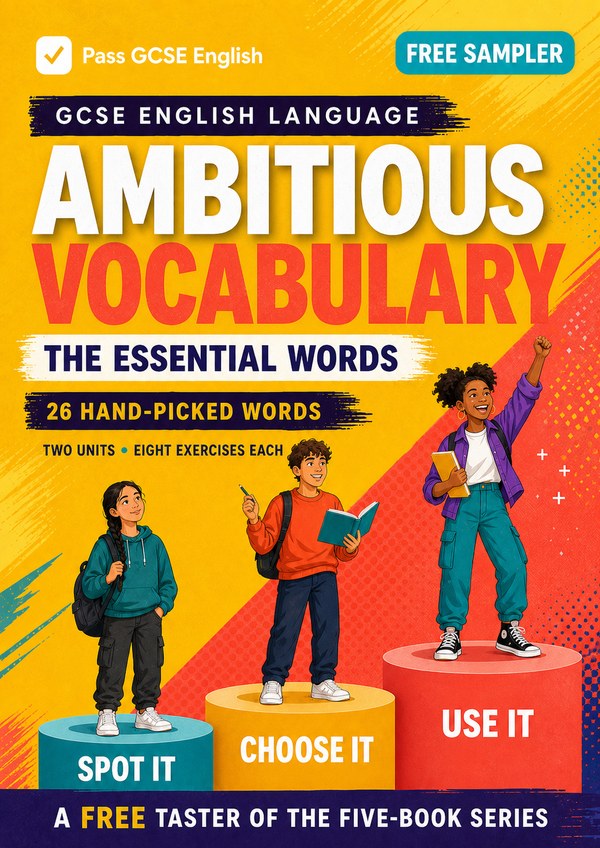
Ambitious Vocabulary for Level 4 — The Essential Words. Twenty-six hand-picked words across two units, the same eight exercises the paid workbooks use, and a full answers section. A working slice of the series, not a teaser with the useful bits removed.
- 18 pages, free, downloads straight away
- Unit 1 aimed at Paper 2, Unit 2 at Paper 1
- Full answers and model responses included
Download it now
Download the free sampler (PDF)
No email address needed and nothing to sign up for. Save it, print it, or work through it on screen.