Built for one specific gap
Ambitious Vocabulary — Workbook 5
Ready to describe colour, texture, sound and weather in a way that actually puts the reader in the room? The descriptive writing vocabulary here is chosen for effect, not for length.
In the exam
Paper 1 Question 5
Marked against
Assessment Objective 6 — descriptive and sensory vocabulary
Share of the GCSE
Part of the 32 marks (20%) for Assessment Objective 6
Book 5 is the descriptive-writing book, and it looks nothing like the other four. The themes are sensory: Colour & Light, Texture & Surface, Sound & Smell, and Space, Weather & World. Inside them you get units on blues, greens and purples; on reds, whites, blacks and neutrals; on light, glow and shadow; on touch, materials and architectural space; on sounds, smell and taste; on synaesthesia — where one sense is described in the language of another; and on weather, landscape, sea and water.
Built for the AQA GCSE English Language (8700) specification — for students sitting the exam in summer 2027, whether you’re resitting or sitting it for the first time.
Look inside
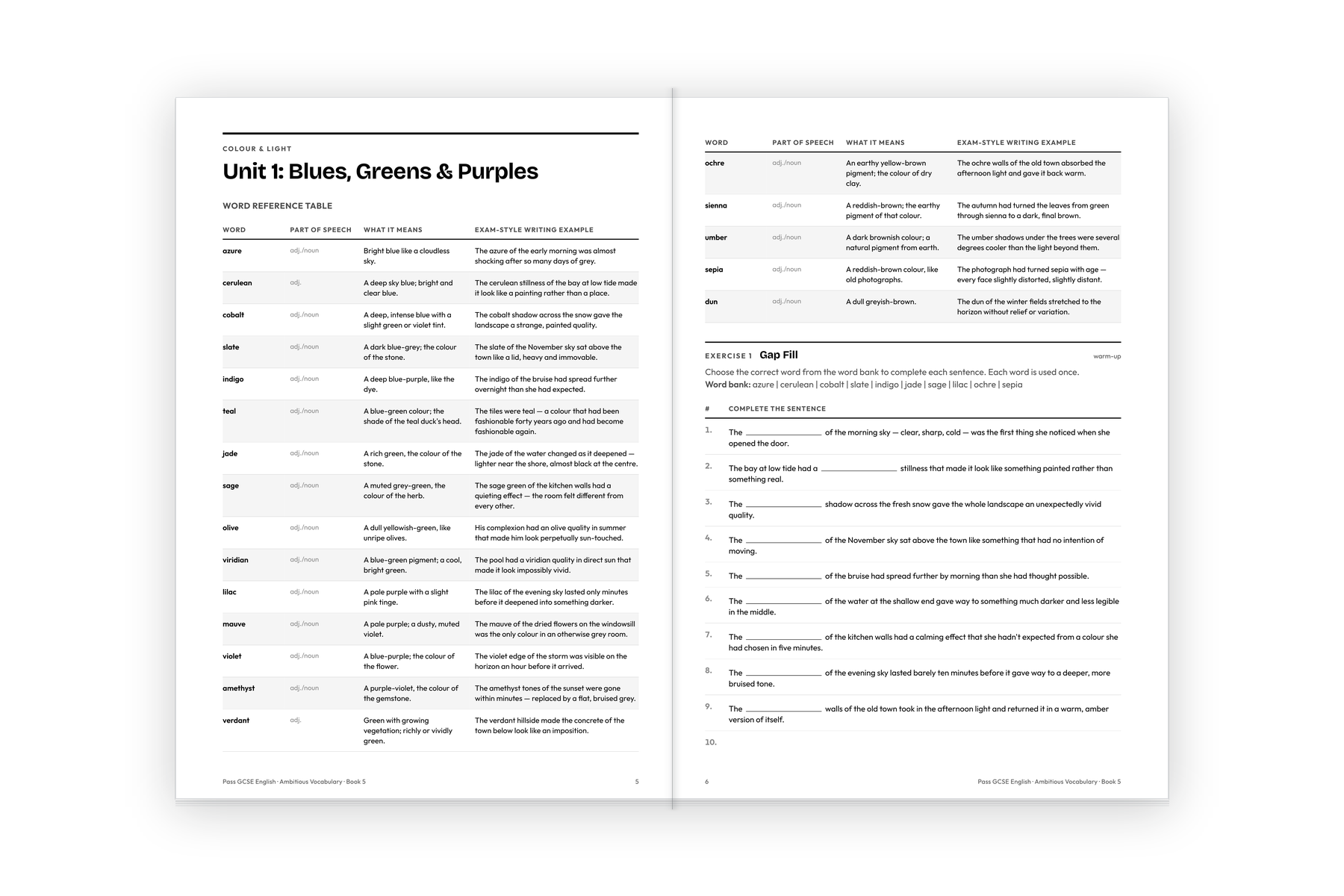
Click the image to see these pages full size.
Pages 5–6 of Book 5: Unit 1, Blues, Greens & Purples — sixteen colour words defined and used in context, then the Gap Fill.
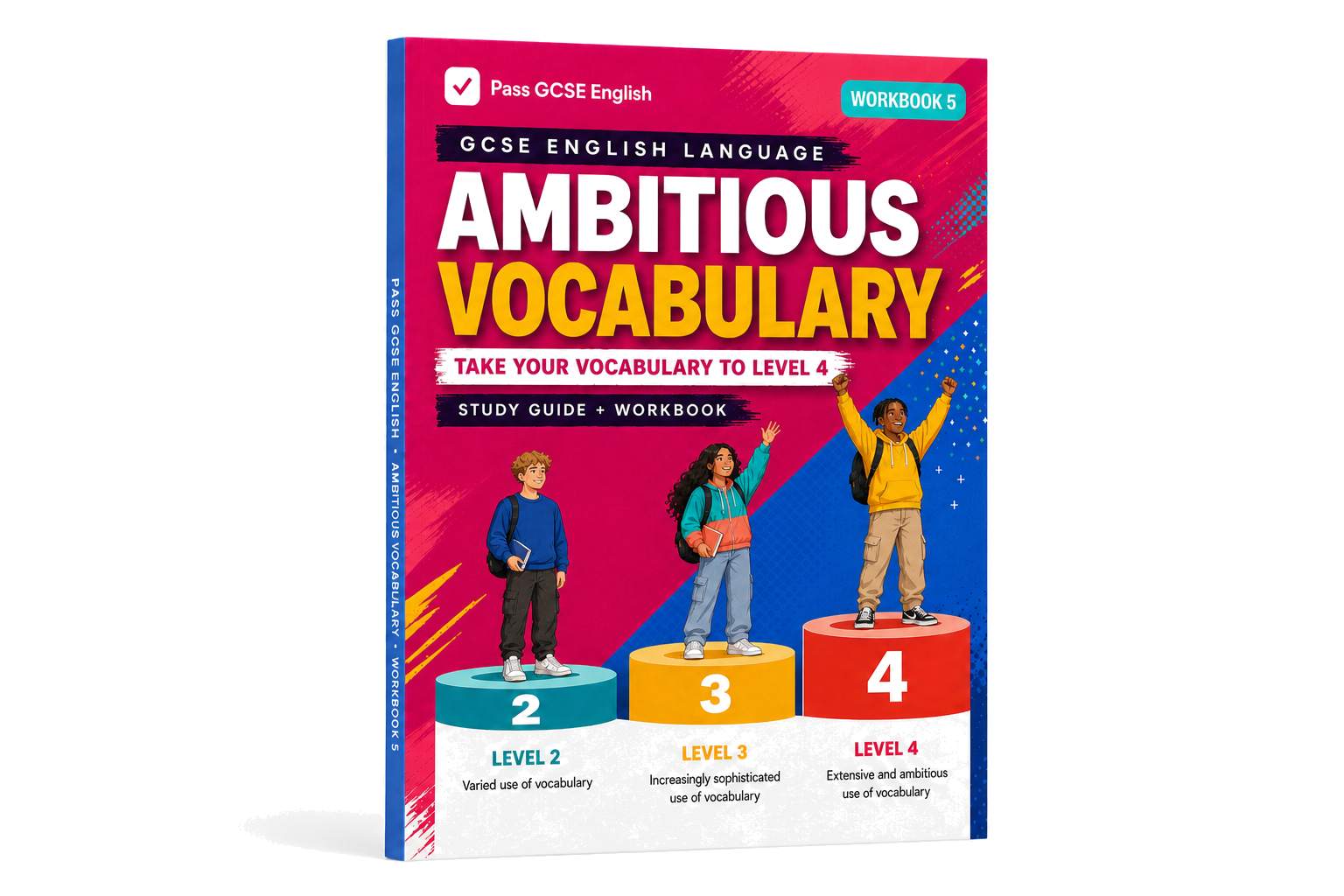
What’s inside
- 12 sensory units across four themes
- Around 20 words per unit — roughly 240 in all
- Eight progressive exercises in every unit
- Full Answers & Model Responses section
- 104 pages, A4, write-in
Why description comes out generic
The scene is clear in your head and vague on the page. The sky is grey, the room is old, the noise is loud — adjectives that could describe almost anything, doing almost no work. It is not that you cannot see it; it is that the specific word for that grey, that age and that noise was never available. The difficulty is rarely a small vocabulary. It is not having a precise sensory word ready when you need one.
This workbook breaks that skill into clear, manageable steps, helping you understand what examiners are looking for and apply it independently.
Built for a specific gap, not a general topic
This workbook is suitable for you if you are:
- Preparing for AQA GCSE English Language
- Wanting descriptive and narrative writing that stops sounding generic — especially if Question 5 keeps coming back marked “more detail”
- Working independently, with a tutor, in class or revising at home
Five things you’ll be able to do
Most descriptive writing fails not for lack of effort but for lack of specific words. This book supplies them, sense by sense.
Name a colour exactly rather than modifying it — and know what each precise shade implies to a reader.
Describe how a surface feels and what a material is, so a setting becomes solid instead of vague.
Write sound and silence with precision, including the vocabulary for smell and taste most students never use.
Describe one sense in the language of another, on purpose — the move that makes description feel written rather than listed.
Apply these skills confidently in exam-style questions.
Guided first, independent by the end
The activities build gradually from explanation and guided practice to independent exam-style work. The eight-exercise sequence is identical to the rest of the series, applied here to sensory vocabulary — so the descriptive words get the same discipline as the analytical ones. You can work through the book in order, or use individual sections to target a particular weakness.
Learn
A reference table teaches twenty sensory words with definitions and exam-style example sentences.
Practise
Connotation Sort and Collocations matter most here — a precise colour word carries feeling, and it keeps particular company.
Apply
Sentence Upgrade and Two Words, One Sentence put the vocabulary straight into description of your own.
What you get across the 104 pages
Blues, Greens & Purples · Reds, Whites, Blacks & Neutrals · Light, Glow & Shadow
Touch & Feel · Architectural & Spatial Qualities · Materials & Natural Surfaces
Sounds · Smell & Taste · Synaesthesia — When Senses Overlap
Weather & Sky · Landscape & Terrain · Sea & Water
Eight per unit — 96 in all — the same sequence as the rest of the series.
Full Answers & Model Responses, including model description rather than one-word keys.
Where this gets you
By the end of the workbook you’ll have specific words for what things look, feel, sound and smell like, your descriptive writing will stop relying on adjectives that could apply to anything, and you’ll have a clearer understanding of how to improve the quality of your answers.
There is no such thing as a “Level 4 word list”. Level 3 sounds like someone starting to reach for it. Level 4 sounds like someone who uses it every time, and always for a reason.
The specifics
- Exam board: AQA
- Format: A4 paperback workbook
- Length: 104 pages
- Subject: GCSE English Language
- Answers included: Yes
- Suggested completion time: Around an hour a unit — 12 to 15 hours in total
- Suitable for: Independent study, revision, tutoring and classroom learning
- Product code: PGE-AV-B5-PB
- Edition: First edition, 2026
- Publisher: Pass GCSE English
- Series: Pass GCSE English
- Book: 5 of 5
This is Workbook 5, the final book in the Ambitious Vocabulary for Level 4 series and the only one built entirely around the senses. If descriptive writing is your weak spot, start here.
Get the free vocabulary sampler
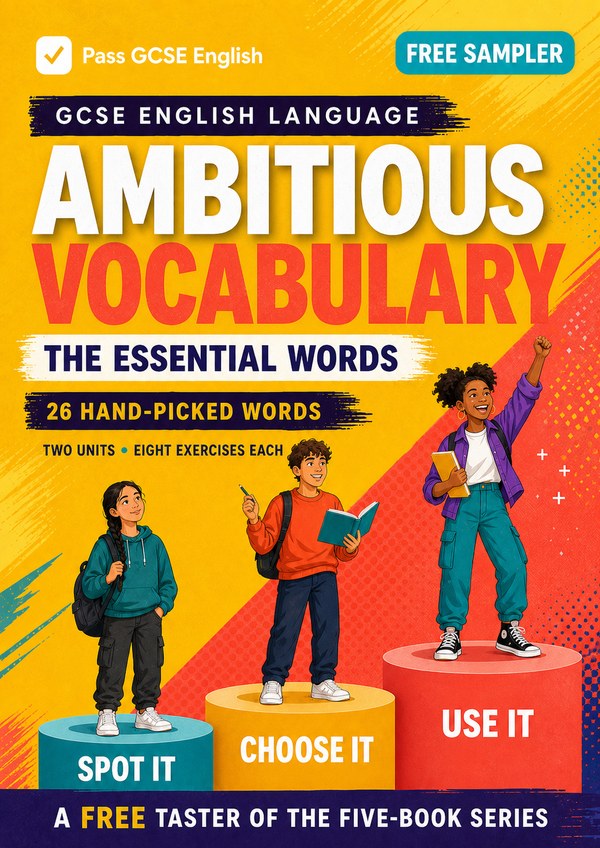
Ambitious Vocabulary for Level 4 — The Essential Words. Twenty-six hand-picked words across two units, the same eight exercises the paid workbooks use, and a full answers section. A working slice of the series, not a teaser with the useful bits removed.
- 18 pages, free, downloads straight away
- Unit 1 aimed at Paper 2, Unit 2 at Paper 1
- Full answers and model responses included
Download it now
Download the free sampler (PDF)
No email address needed and nothing to sign up for. Save it, print it, or work through it on screen.