
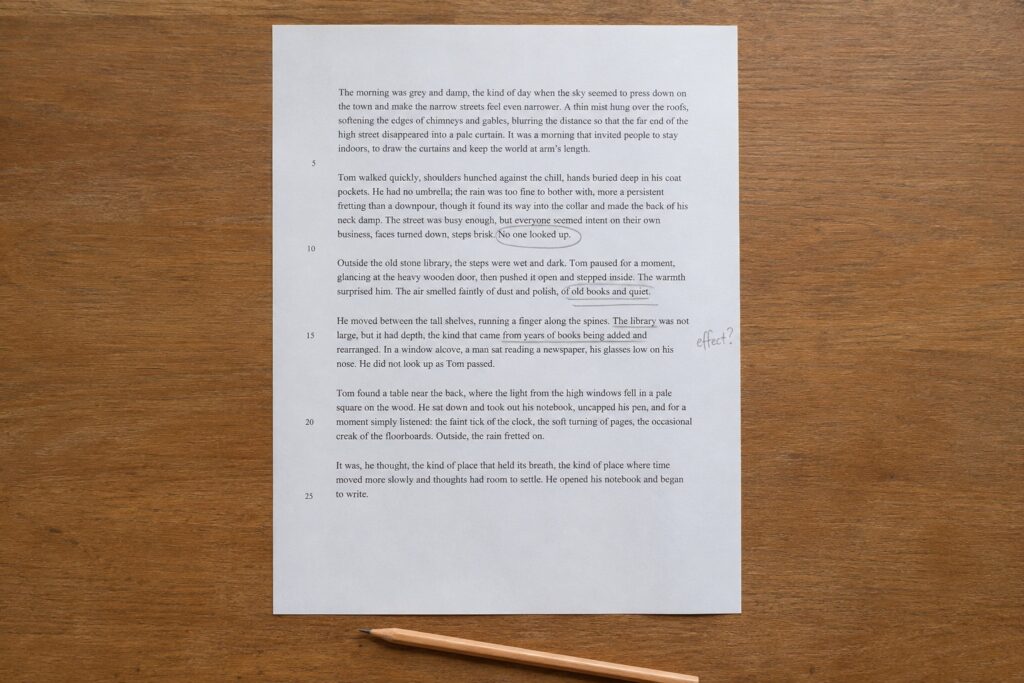
You read the extract and you can see what the writer is doing. There is a metaphor in the second line. There is a list. The sentences get shorter towards the end. You underline them, write that they create imagery for the reader, and move on — and when the paper comes back, Question 2 has three marks on it.
This is one of the most common places for marks to disappear on Paper 1, and it is almost never because a student cannot spot techniques. It is because spotting is not what the question is asking for.
The short answer
Question 2 is worth 8 marks. It directs you to a short, specified section of the source and asks how the writer uses language to achieve a particular effect. You are marked on selecting precise evidence, explaining what that choice does to a reader, and supporting it with accurate subject terminology.
What Question 2 is assessing
Question 2 is marked against Assessment Objective 2, which AQA words as: explain, comment on and analyse how writers use language and structure to achieve effects and influence readers, using relevant subject terminology to support their views.
Only the language half of that applies to Question 2. Structure is Question 3.
Three things are worth pulling out of that sentence. Analyse, not identify — naming a technique is the first two seconds of the job, not the job. Effects, and influence readers — the mark sits in the consequence of a choice, not the choice itself. Relevant subject terminology — terminology supports a point you are already making, and a list of correctly named features with nothing said about them will not get you far.
One more thing, and it is the one students most often skip. The question always gives you a precise focus: how the writer describes the setting, conveys a character’s mood, or presents a place. That focus is what you have to answer. Language chosen brilliantly for something else will not score.
A sensible guide is around ten minutes for this question. It is a focused, short answer — not an essay.
A method that works
- Read the question first and underline the precise focus. Before you look at the extract, know what you are looking for.
- Read only the lines you have been given. Question 2 specifies them, so keep your evidence inside those lines.
- Choose two or three short quotations that do that specific job. Short is better. A single word can be analysed properly; half a paragraph usually cannot.
- For each quotation, work through three things. What does that word suggest, beyond its plain meaning? What does it make a reader picture or feel? Why that word rather than the ordinary alternative?
- Name the technique where it helps. If naming it sharpens your point, name it. If it does not, leave it out and keep going.
Three points explained properly will beat six features listed.
A worked example
Here is a short original extract, written for this article.
The kitchen had been holding its breath since Tuesday. Plates stood in the rack where he had left them, dry now, chalked with old water. On the table a mug waited, half an inch of tea gone to a skin, and beside it the radio muttered on to nobody, working through a shipping forecast for seas three hundred miles away. Margaret stood in the doorway with her coat still buttoned, and did not go in.
The question: How does the writer use language here to convey the atmosphere in the kitchen?
A weak answer
The writer uses personification when they say the kitchen “had been holding its breath”. This makes the kitchen seem like a person and creates a vivid image for the reader. There is also a list of objects — plates, a mug, a radio — which shows what is in the kitchen. The verb “muttered” is onomatopoeia and makes the reader feel like they are there. The writer also uses the adjective “old” to describe the water, which creates imagery.
Nothing there is careless. The student has read the extract and found real things in it. But four techniques are named and none is explained. “Creates imagery” and “makes the reader feel like they are there” could be written about any extract in any paper. And “muttered” is not onomatopoeia — a wrong label costs more than no label.
A stronger answer
The writer personifies the kitchen as “holding its breath”, which makes the room seem tense and waiting rather than simply empty. A breath is held in anticipation of something about to happen, and holding it “since Tuesday” stretches that anticipation far past the point of comfort — the room, like Margaret, is suspended between an event that has happened and one that has not.
That suspension is reinforced by the state of the objects. The plates are “dry now, chalked with old water” and the tea has “gone to a skin”. Both are traces of ordinary activity that stopped and was never picked up again, and the adverb “now” quietly measures how long ago that was. Nothing has been cleared away, because nobody has been able to.
The radio is the sharpest of these choices. It “muttered on to nobody” — a low, half-heard, faintly resentful sound, addressed to an absence the sentence insists on naming. Its subject widens that absence further: a forecast for “seas three hundred miles away” is news that has nothing to do with this room, still being delivered to it.
Why the second answer is better
It is not longer for the sake of it, and it does not use more terminology. It uses less.
It answers the question that was asked. Every point is about atmosphere. The weak answer describes features; the strong one describes an effect.
It picks fewer quotations and stays with them. Three quotations, each developed. The weak answer touches five things and lands on none.
It says what a word suggests, not that it suggests something. “Muttered” is unpacked as low, half-heard and resentful. That is an effect. “It creates imagery” is a placeholder where an effect should be.
It connects choices to each other. The later paragraphs build on the tension established in the first, so the answer reads as one argument about the room rather than three unrelated observations.
Terminology supports the point rather than replacing it. “Personifies” and “adverb” appear once each, doing a job. Nothing is named just to prove it can be.
Where the marks usually go
Technique-spotting. Identifying is worth almost nothing on its own. If your sentence ends at the name of the device, the mark ends there too.
Vague effect statements. “It creates imagery”, “it makes it more interesting”, “it draws the reader in”, “it emphasises it”. If the sentence would fit any extract you have ever read, it is not analysis.
Feature listing. Six techniques named in a row reads as a checklist. Examiner-style guidance would be the same every time: choose fewer and go further.
Forgetting the question. Drifting into what happens in the extract, or into structure, or into evidence from lines you were not given. All of it is unmarkable here, however well written.
Quoting too much. A four-line quotation usually means the specific word doing the work has not been found yet.
Guessing the terminology. A wrong label undermines an otherwise good point. If you are not certain it is sibilance, say what the sound does instead.
Three to practise
Spend about five minutes on each. Aim to develop two carefully chosen quotations.
- The corridor smelled of wet coats and disinfectant, and every door along it was shut.
How does the writer use language here to convey the atmosphere? - He signed his name the way he always did, quickly, as though the paper might change its mind.
How does the writer use language here to present the man? - By four o’clock the snow had given up trying to settle and turned to a grey wet that got into everything. The van coughed twice on the hill and then thought better of it.
How does the writer use language here to describe the conditions?
For each one: what does the word suggest, what does it make a reader feel, and why that word rather than the ordinary alternative?
If this is the gap costing you marks
Most students who lose marks on Question 2 are not short of techniques. They can find a simile in seconds. The difficulty is that an extract offers several, and some fit the precise focus much better than others. Knowing which to choose is a skill that has to be practised rather than explained once.
That is what Language Techniques & Methods is built around. Every extract in it contains two examples of each technique, and only one creates the effect you have been asked about, so you cannot answer by recognition alone. Full answers explain why each decoy is tempting and why it is wrong.
Practise choosing evidence, not just spotting techniques
Language Techniques & Methods gives you original extracts with deliberate decoy examples, worked answers and a marking toolkit. It is a 164-page printed, write-in workbook for the AO2 skill tested here.
£14.99 · Free UK delivery
It is one of eleven workbooks, each built for a different gap. You do not need all of them — start with the one costing you the most marks.
If you would rather begin at no cost, there are free resources including a vocabulary sampler with full answers and no email address required. And if you are working out what to do after a disappointing result, this guide to your options after a grade 3 sets out the November and summer routes.
In short
Question 2 rewards precision, not coverage. Read the precise focus named in the question, stay inside the lines you have been given, choose two or three short quotations that genuinely address that focus, and say clearly what each one does to a reader and why the writer chose it.
Then take one of the three practice sentences above and write four sentences on it. Four careful sentences will teach you more about this question than an hour of reading about it.